Purpose
This document provides clinical guidance for all staff involved in the care and management of a child presenting to an Emergency Department (ED) in Queensland with eczema.
This guideline has been developed by the Dermatology Service, Queensland Children’s Hospital, with input from senior ED clinicians and Paediatricians across Queensland. It has been endorsed for use across Queensland by the Queensland Emergency Care of Children Working Group in partnership with the Queensland Emergency Department Strategic Advisory Panel and the Healthcare Improvement Unit, Clinical Excellence Queensland.
Introduction
Eczema, also known as atopic dermatitis (AD), is a chronic inflammatory pruritic skin disease characterised by flare-ups and remissions.
Eczema is very common affecting 30% of Australian children.2,3 It is highly heritable with other family members often suffering from eczema or other atopic disorders (such as allergic rhinitis or asthma). In 60% of cases, the onset of eczema typically occurs in the first year of life (commonly at three to six months of age) with 90% developing symptoms by five years of age.2,4
Children with untreated moderate-to-severe eczema, under six months of age, go onto have a higher incidence of food allergies. For this reason, all causes of moderate-to-severe skin conditions that started under 6 months of age should be considered a priority when making follow up arrangements.
Eczema cannot be cured but can be effectively managed. The majority of children grow out of eczema by 16 years of age.
Pathogenesis
Eczema is thought to be caused by a complex interplay between genetic defects in skin barrier function, upregulation of inflammatory cytokines and environmental factors (such as second-hand smoke, climate, soaps).
Clinical presentation
While eczema normally affects the flexural surfaces (i.e. cubital fossa, popliteal fossa), the face, neck and extensor surfaces may be affected in children. The nose, groin and axillary regions are typically spared. Clinical presentation varies depending on the age, environment and ethnicity of the child.2,7,9
Superimposed bacterial or viral infections can occur due to the disordered barrier function and reduction in antimicrobial function of the skin. Bacterial infections are commonly caused by Staphylococcal aureus (impetiginized eczema) or Streptococcal species. Viral infections include eczema herpeticum (typically due to HSV type 1 or 2, presents 5-12 days after contact with an infected individual) and eczema coxsackium (enterovirus). Co-infections can occur.
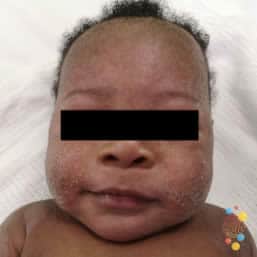
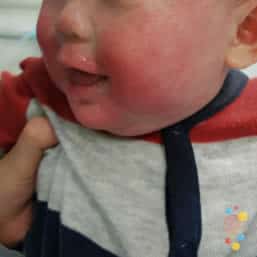
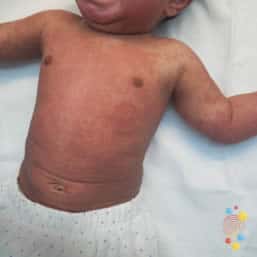
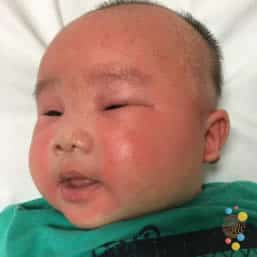
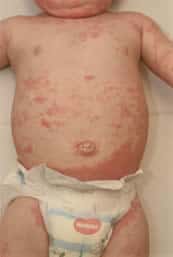
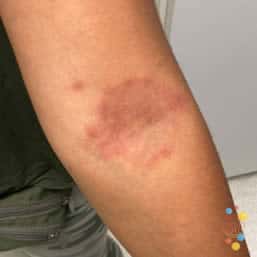
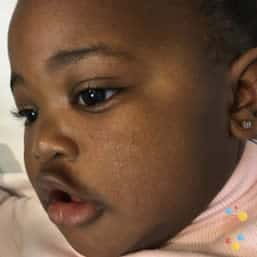
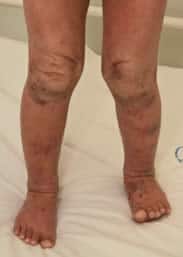
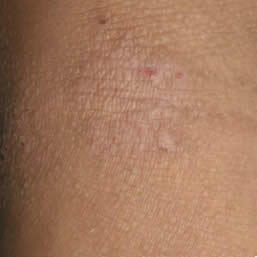
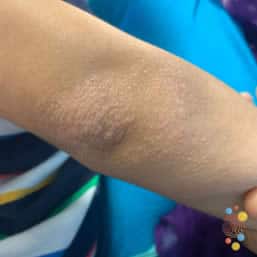
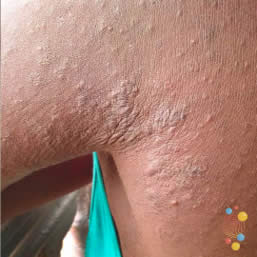
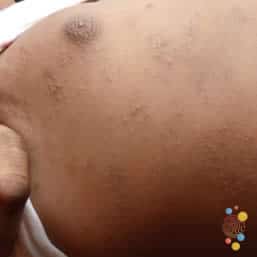
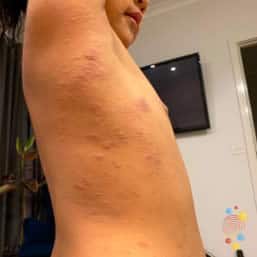
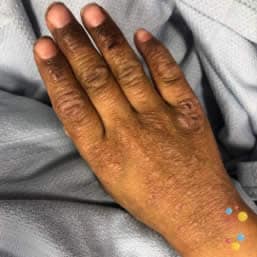
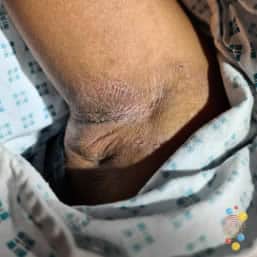
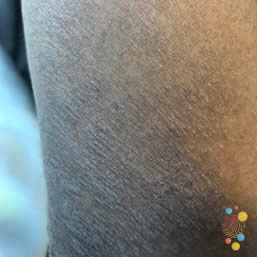
Clinical presentation of eczema by age| Presentation |
|---|
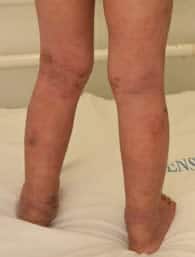
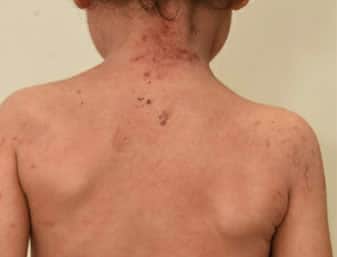
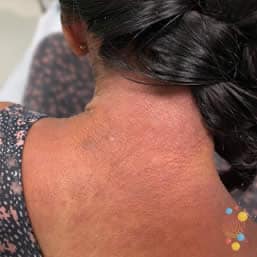
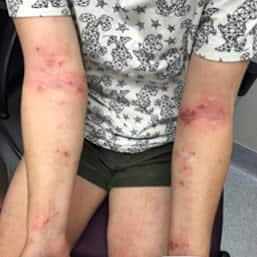
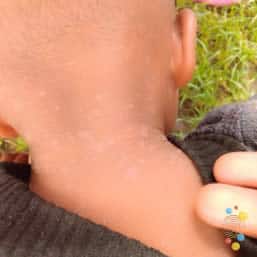
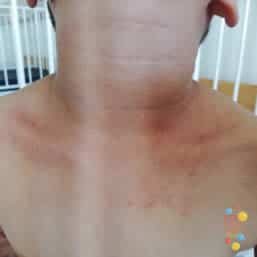
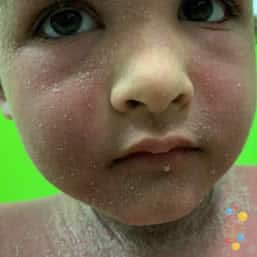
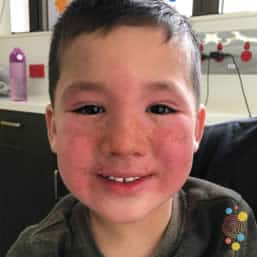
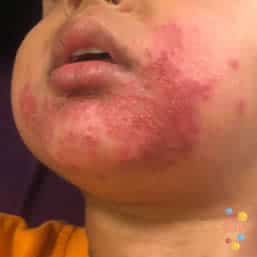
Birth to 6 months | Lesions exudative erythematous weepy papules and plaques. Particularly on the face. Examples Images provided by Don’t Forget the Bubbles – Skin Deep https://dftbskindeep.com |
6 months to 12 years | Erythematous papules and plaques intermixed with lichenified plaques, often with erosions particularly in flexural areas. Examples Images provided by Don’t Forget the Bubbles – Skin Deep https://dftbskindeep.com |
Over 12 years | Erythematous papules and plaques with xerotic scale and crust found on scalp, face, trunk, extensor surfaces or flexural surfaces. Lichenified plaques common in flexural or extensor surfaces depending on ethnicity. Examples Images provided by Don’t Forget the Bubbles – Skin Deep https://dftbskindeep.com |
Descriptors of Eczema| Description |
|---|
Papules | - Elevated, solid, palpable lesions.
- ≤ 1 cm in diameter.
- May be solitary or multiple.
- Do not contain fluid.
Examples Images provided by Don’t Forget the Bubbles – Skin Deep https://dftbskindeep.com |
Lichenification | Palpably thickened skin with increased skin markings and lichenoid scale (caused by chronic rubbing). Example Images provided by Don’t Forget the Bubbles – Skin Deep https://dftbskindeep.com |
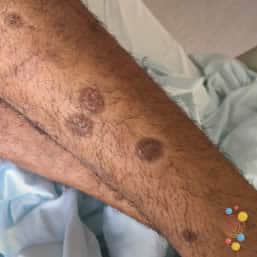
Discoid or nummular eczema | - Papules or papulovesicles coalesce into coin-shaped patches.
- Often associated with chronic disease.
- Will require antibacterial baths.
Example Images provided by Don’t Forget the Bubbles – Skin Deep https://dftbskindeep.com |
Post inflammatory hypo/hyperpigmentation (secondary to resolved eczema) | Hypo or hyper-pigmented macules in sites of resolved eczema. A response to inflammation; NOT due to topical cortisone use. Will resolve overtime, once eczema has not affected the area for at least 6 months. Example Images provided by Don’t Forget the Bubbles – Skin Deep https://dftbskindeep.com |
Assessment
The aim of the assessment is to:
- Identify children with a superimposed infection to enable appropriate treatment and, if required, specialist referral.
- Understand the extent and severity of disease to enable appropriate skincare management plan and need for specialist referral
- Identify moderate to severe eczema starting before 6 months of age and consider follow up targeted toward this group’s higher risk of food allergy.
History
History taking should include specific information on:
- Onset and duration of symptoms
- Effect on sleep (how much they wake due to itch) and number of days of school (or parents work) missed due to eczema
- Recent impact on quality of life and psychological well-being (e.g. restriction of activities, school absence, sleep disturbance)
- Recent symptoms suggestive of an infection. Please note severe skin disease is associated with temperature dysregulation and particularly a tendency toward hypothermia.
- Previous history/family history of atopy
- Usual topical skin care regimen
- Dietary and growth history – specifically ask about consumption and exposure to staple allergenic foods ( dairy, egg, wheat, soy , seafood, nuts, sesame)
Examination
A holistic approach to examination should be taken; consider both the severity of the child’s eczema and also, the impact it is having on psychosocial wellbeing.
Holistic assessment| Impact on quality of life and psychosocial wellbeing |
|---|
| Clear | - normal skin, no evidence of active atopic eczema
| - none: no impact on quality of life
|
| Mild | - areas of dry skin, infrequent itching (with or without small areas of redness)
| - little impact on everyday activities, sleep and psychosocial wellbeing
|
| Moderate | - areas of dry skin, frequent itching, redness (with or without excoriation and localised skin thickening)
| - moderate impact on everyday activities and psychosocial wellbeing, frequently disturbed sleep
|
| Severe | - widespread areas of dry skin, incessant itching, redness (with or without excoriation, extensive skin thickening, bleeding, oozing, cracking and alteration of pigmentation)
| - severe limitation of everyday activities and psychosocial functioning, nightly loss of sleep
|
Refer to the introduction for examples of papule, lichenification, discoid, nummular eczema and bullous impetigo.
Clinical features of superimposed infections
| Description |
|---|
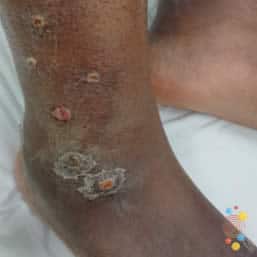
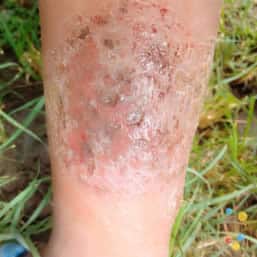
Impetiginised eczema | - Presents with single or multiple crops of papules and plaques, often with a yellowish crust.
- Can affect any part of the body, but may be more common where the skin has been scratched. A clue is that new lesions outside of usual eczema area have recently appeared.
- Facial lesions may involve the nares but mucosal membranes are spared.
- Infection with group A beta-haemolytic streptococcus can cause non-bullous impetigo (Streptococcus pyogenes).
Example Images provided by Don’t Forget the Bubbles – Skin Deep https://dftbskindeep.com |
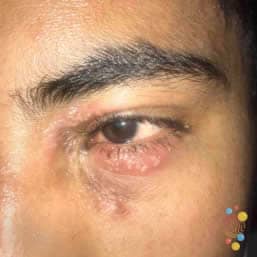
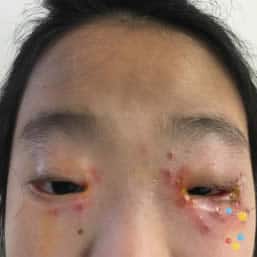
Eczema herpeticum | - Clusters of itchy, usually painful blisters and punched out erosions.
- Blisters/erosions are monomorphic and may be filled with clear yellow fluid or purulent material.
- Old blisters crust over and form sores.
- Can affect any part of the body but typically face and neck.
- +/- fever or systemic illness.
- Repeated episodes should be investigated and considered for prophylaxis in consultation with Paediatric Infection Specialist.
Example Images provided by Don’t Forget the Bubbles – Skin Deep https://dftbskindeep.com |
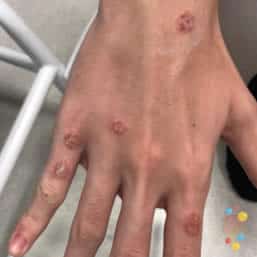
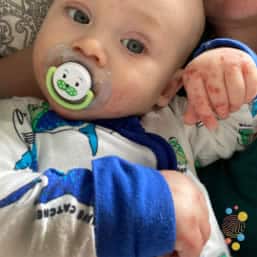
Eczema coxsackium | - Typical hand-foot-and-mouth disease with widespread rash of erythematous, crusted lesions that can appear targetoid.
- Often in unusual areas such as the ears.
- Lesion can appear similar to eczema herpeticum but child is less irritable as “pain” is not a feature of eczema coxsakium.
Example Images provided by Don’t Forget the Bubbles – Skin Deep https://dftbskindeep.com |
Bullous impetigo | - Small vesicles that evolve into transparent flaccid bullae.
- Heals without scarring.
Example Images provided by Don’t Forget the Bubbles – Skin Deep https://dftbskindeep.com |
Investigations
Investigations such as lesion swabs are only indicated for children with suspected bacterial or viral infection. Request bacterial culture (m/c/s) and HSV PCR; VZV PCR if varicella is suspected.
If a viral skin infection is suspected in a child with blisters, rupture the blister and firmly swab the base of the lesion with a dry (no medium) swab.
Seek senior paediatric or dermatology advice for children with moderate to severe disease. Ophthalmology advice either locally or via CATCH should be sought for suspected viral infections involving or possibly involving the ophthalmic branch of the trigeminal nerve.
Differential diagnoses for eczematous lesions
- Infantile seborrhoeic dermatitis (generally not itchy)
- Tinea (dermatophyte)
- Scabies (sudden onset of burrows, papules and pustules to palms, soles and webbing in non-atopic child with family history of pruritus, papular pruritic rash to torso and limbs may follow)
- Periorificial dermatitis (small erythematous papules around mouth, nose, and eyes, exacerbated by moderate or potent steroids)
- Psoriasis (itchy, well-defined, salmon pink, silvery scaly plaques on extensor surfaces of elbows, knees, and also scalp)
- Miliaria
- Zinc deficiency/other nutritional deficiency
- Other
Management
Seek senior emergency/paediatric advice for a child with mild to moderate eczema who is febrile or unwell. The mainstay of eczema management revolves around education and development of a skincare management plan.
Education
Parents/carers should receive education regarding:
- Eczema symptoms (xerosis and inflammation), come and go in a cyclical fashion.
- Brief pathophysiology of disordered barrier function leading to increase permeability (water loss), reduction of natural moisturising factors, decreased microbial function, and immune dysregulation (over-active immune response to the environment).
- Need for an everyday skincare management plan (to minimise xerosis and therefore pruritus) and a flare management plan to control flares quickly, improving sleep and quality of life.
- Role of allergens (such as house dust mite, animal dander, and pollens) – may be contributory but do not cause eczema.
- Food allergies coexist in 10-20% of children with eczema10-12 however, they are not the cause of eczema. It is important that the child is still exposed to all allergenic foods. Any concern of immediate allergic symptoms (e.g. urticaria or angioedema, GI symptoms or signs of anaphylaxis) may be referred to General Paediatrics or Immunologist/Allergist.
- Flares associated with food
- require clear and reliable signs of a significant flare within two hours of food ingestion
- different to a food allergy
- providing the flares can be managed, the food can remain in the diet
- perioral rash in babies and toddlers after feeding could be an irritant eczematous rash from the contact of food to the skin and may not be an allergy
- Please see link https://preventallergies.org.au/eczema/eczema-and-food-allergy/ for further information.
- Topical corticosteroids
- Early, liberal use is recommended as this limits the total dose given over time.
- Use daily until the eczema is clear.
- Side effects (thinning of the skin and telangiectasia) are usually only associated with inappropriate use e.g. daily use of potent corticosteroids, on normal skin, over many months.
- Hypopigmentation or hyperpigmentation is NOT a side effect of topical corticosteroids, rather a temporary result of the inflammatory process of eczema. This is not scarring. Pigment will normalise over time.
Skincare management plan
View: Eczema Action Plan [PDF]
Everyday skincare treatment
- Daily bath (or shower for teenagers) with a soap substitute (e.g. aqueous cream cleanser or soap free wash/bath oil)
- For very young infants, bathing just once or twice per week is appropriate
- Consider twice weekly antibacterial baths Refer to Eczema: Baths and video for further information.
Potassium permanganate (Condy’s Crystals) if prone to regular infections.
Add a very small amount to bath to make water PALE PINK in colour.
The colour is best determined in a white bath. If this is not possible, scoop out some solution in a clear jug to determine colour.
Soak child for approx. 10 minutes. Use a face washer to wash face with solution **Caution: This over-the-counter product is corrosive when undiluted. Avoid contact of the crystals or strong solutions with the eyes, mouth, nose and other mucous membranes.
- Bleach baths8 and salt if prone to regular flares
Add 12mL of sodium hypochlorite 4% bleach and 1/3 of a cup of pool or table salt to 10L water. Measure how many 10L buckets fill the bath to the desired level and write this down. Add 12mL of sodium hypochlorite 4% bleach for every 10L water. Add 1/3 cup of pool or table salt for every 10L water. **Caution: These over-the-counter products can be corrosive when undiluted. Avoid contact with the eyes, mouth, nose and other mucous membranes. Use caution to avoid bleaching of clothing and surfaces with undiluted bleach.
If access to a bath is limited OR only a small area of the body is affected, localised soaks to the area can be done. A bucket filled with either potassium permanganate or bleach an salt solution listed above can be used; soak a cloth in the solution and hold onto the affected areas. Repeat for 5-10 minutes.
- Regular moisturiser head-to-toe (from two to six times daily)9,10
- Ointments are preferred over creams where tolerated.
- Creams will often sting very dry skin or broken skin.
- Avoid “natural”, animal, plant-based moisturisers or moisturises with food products e.g., nuts
- Avoid irritants/triggers: soap, frequent shampooing of hair and, where possible, heat, and sweat.
- For infants/toddlers: Minimise skin contact with saliva and foods.
- Wipe face regularly with wet cloth to remove saliva/food and apply thick barrier emollient.
- Mineral based sunscreens are preferred as they are less likely to irritate the child’s skin. These include Zinc or titanium dioxide as ingredients. Chemical blockers are more likely to irritate the skin with eczema.
Flare treatment
- Continue everyday skincare treatment as per above
- Add daily antibacterial or anti-inflammatory baths daily for moderate to severe flares – Refer to Eczema: Baths and video for further information. Continue for 2 weeks then reduce to maintenance twice weekly as above.
- Topical corticosteroids (in line with disease severity) are recommended for once daily administration to eczematous areas until clear. The order of application of moisturiser and corticosteroid does not affect efficacy.
- There is little evidence twice or thrice daily application is more beneficial; for those who are admitted with severe exacerbation of eczema, twice daily application of topical corticosteroid for the duration of admission is often prescribed. Inpatient care is focused on skin condition optimization.
- There is a theoretical risk that topical corticosteroid applied over HSV vesicles may result in worsening infection. However, in most cases, controlling the underlying eczema with topical corticosteroids is more effective in preventing the spread of HSV.
- Topical corticosteroids should be used on raw and excoriated areas, even where bacterial superficial infection is suspected or proven.
Topical corticosteroids – Ointments vs creams vs lotions
The efficacy of the medication changes depending on the vehicle it is in. The most effective regime is one that is tolerated by the patient and family. This will be different for each child, and is often a combination different vehicles (e.g. ointment in worst areas/broken skin/at night when not hot and cream/lotion in other areas/ for maintenance/ during hotter times of the day).
- Ointments (oil/lipid base with no water) are preferred as they are more occlusive and are more effective at delivering the medication into the skin. They also provide an effective skin barrier to reduce water loss. Skin water loss impairs delivery of treatments into the skin.
- Creams (oil and water base, emulsified) and lotions (thinner emulsified oil and water base or alcohol based) may be appropriate for the scalp or very hairy areas.
- Creams may sting when applied to broken skin
- Lotions can contain alcohol and often sting broken skin, so they may not be well tolerated. Creams are recommended if lotion is not able to be tolerated in the child with an excoriated scalp for example
- Ointments reduce trans-epidermal water loss which also impairs heat loss. Ointments can cause overheating.
- For moderate to severe eczema add wet wraps/garments. Refer to Eczema: Wet Wraps.
Topical corticosteroids dosing for the treatment of eczema flares in children| A fingertip unit (FTU) is from distal phalanx to tip of finger of an adult hand. A single FTU of topical corticosteroid will cover the equivalent of two adult hands of eczema and is equivalent to 0.5 g of topical corticosteroid. Calculate the number of grams required per application to determine how many tubes are required per script. There are PBS streamline authority codes for prescription of multiple tubes. |
Topical steroids for the treatment of eczema in children| Active Ingredient | Use |
|---|
|
Class I (mild)
|
LAM Listed:
Hydrocortisone acetate – cream or ointment 1% (eg Sigmacort / Cortic-DS brands) 30g sizeNon LAM listed options for supply from outside QH:
- Hydrocortisone acetate – cream or ointment 1% (eg Sigmacort / Cortic-DS brands) 50g size
- Hydrocortisone cream 1% (Derm-aid brand) 30g
|
Mild face / neck / genital inflammation
|
|
Class II (moderate)
|
LAM Listed:
Triamcinolone 0.02%
- cream 100g – Restricted to Specialist staff, Country Medical Superintendents and Endorsed Podiatrists (eg Aristocort brand)
- ointment 100g – unrestricted
Betamethasone valerate 0.03% and clioquinol 0.9% (anti-microbial) in Aqueous Cream, 50g, QH Compounded - Non LAM listed (IPA required or organise for supply from outside QH:Methylprednisolone aceponate 0.1% – Advantan (fatty ointment, ointment, cream, each 15g) or lotion 20 g
- Use for moderate-severe facial inflammation
|
Mild to moderate body and scalp inflammation
Moderate/severe face / neck / genital inflammation Mild to moderate body and scalp eczema with excoriations; minimize the risk of superficial infection |
|
Class III (potent)
|
LAM listed:
Betamethasone dipropionate 0.05% (Plain base)
- Ointment or cream – 0.05% in 15g or 50g, (eg Diprosone or Eleuphrat brand) – Unrestricted
- Lotion 30 mL (Diprosone brand) – unrestricted
Mometasone Furoate 0.1% - Ointment 15g or 50g, (eg Elocon / Zatamil brands)
- Cream 15g or 50g, (eg Elocon Novasone brands
- Lotion (eg Elocon / Zatamil brand) 30 mL
|
Moderate to severe body and scalp inflammation
|
|
Class IV (very potent)
|
LAM Listed:
- Betamethasone dipropionate GLYCOL 0.05% (Optimised vehicle) Cream 30g (Diprosone OV Cream)
Non LAM Listed (IPA required or organise for supply from outside QH: - Betamethasone dipropionate GLYCOL 0.05% (Optimised vehicle) Ointment 30g (Diprosone OV ointment)
Clobetasol propionate 0.05% - Clobex Shampoo 500mL (not on LAM – individual patient approval required prior to supply)
|
Severe inflammation
Dermatologist only |
Treatment of superimposed infections
Bacterial infection
Oral antibiotics are recommended following a lesion swab.
Oral antibiotic dosing for the treatment of superimposed bacterial infection in child with eczema (dosing for infants and children > 1 month of age with normal renal function and appropriate allergy history).
Refer to CHQ Antibiocard for more information – Children’s Health Queensland Paediatric Antibiocard: Empirical Antibiotic Guidelines [PDF 854.34 KB]
Viral infection
Antiviral dosing for the treatment of superimposed herpetic infection in child with eczema (dosing for infants and children > 1 month of age with normal renal function).
| Valaciclovir (oral) |
20 mg/kg every eight hours (up to a 1g) for 7 days
Oral preferred route. Good oral bioavailability.
ID approval required
|
| Aciclovir (IV) |
If systemically unwell and unable to tolerate oral therapy:
Aciclovir IV 10 mg/kg (up to 500 mg) every eight hours for seven days only if able to be commenced within 72 hours of the appearance of the first lesion.
ID approval required
|
Treatments NOT recommended
- Avoid topical antibiotics (i.e. Bactroban, mupirocin) as this is less effective and may contribute to antibiotic resistance in moderate to severe cases.
- Antihistamines – may be useful for allergic rhinitis but do not significantly decrease the itch associated with eczema (eczema is not histamine related).
- Restrictive diets.