This document provides clinical guidance for all staff involved in the care and management of a child presenting to an Emergency Department (ED) in Queensland with a suspected or confirmed foreign body in the ear.
This guideline has been developed by senior ED clinicians and Paediatricians across Queensland, with input from ENT, Queensland Children’s Hospital, Brisbane. It has been endorsed for use across Queensland by the Queensland Emergency Care of Children Working Group in partnership with the Queensland Emergency Department Strategic Advisory Panel and the Healthcare Improvement Unit, Clinical Excellence Queensland.
Aural foreign bodies are more common in the following children:
Beads, plastic toys, pebbles and food are the most common objects inserted. Older children may present with insects in the external auditory canal. Foreign bodies are most frequently found in the right ear due to predominant right handedness.
Button batteries require immediate removal due to the risk of necrosis of the surrounding tissue.
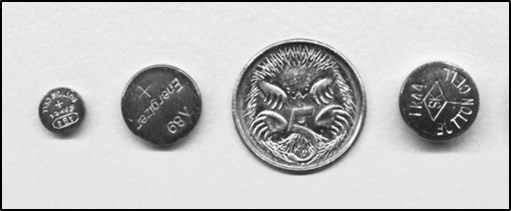
There are two main mechanisms by which button batteries can cause necrosis:
Despite prompt removal, the risk of injury can continue up to weeks post-insertion due to residual alkali and weakened tissues.
Button batteries require immediate removal to prevent necrosis of surrounding tissue.
Most children with a foreign body in the ear canal are asymptomatic. A history of insertion may be reported by the child or the caregiver. The foreign body may have been visualised on routine otoscopy. Delayed presentations are usually triggered by parents noticing blood stained purulent discharge or a bad smell.
Regardless of a history of insertion, consider an aural foreign body in children presenting with any of the following symptoms:
| Differential diagnoses for suspected aural foreign body |
|---|
| Cholesteatoma |
| Infection |
| Trauma |
X-rays are recommended if there is the possibility of button battery insertion which cannot be directly visualised.
Contact Retrieval Services Queensland (RSQ) to arrange urgent transfer of a child with a suspected button battery in the ear and no X-ray facilities onsite.
Refer to flowchart [PDF 209.1 KB] for a summary of the emergency management for a child with an aural foreign body.
Urgent ENT referral (onsite or via RSQ) is required for a child with an aural button battery.
Refer to ENT as per local practices in the following circumstances:
Regional auricular blocks are not recommended as are rarely tolerated (due to the multiple punctures required) and may not produce complete anaesthesia.
| Extraction method | Indication and notes | |
|---|---|---|
| Mechanical extraction |
Forceps (including Magill, alligator, packing, toothed and non-toothed forceps) |
|
|
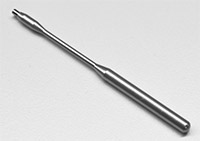
Probe/ hook/ curette (including Jobson-Horne probe, cerumen hooks) |
| |
| Suction |
| |
Magnetic device![]() |
| |
| Irrigation |
| |
Irrigation is contraindicated in the following cases:
Refer to ENT as per local practice if the first attempt at removal of foreign body (via any method) is unsuccessful.
There is no evidence for prophylactic use of antimicrobial drops if there has been minor trauma to the external auditory canal following foreign body removal. Consider drops only in cases where there has been mucosal breach.
| Topical corticosteroid and antimicrobial dosing for children with significant external auditory canal trauma following foreign body removal | ||
|---|---|---|
| No perforation | Dexamethasone 0.05% + framycetin 0.5% + gramicidin 0.005% ear drops (SOFRADEX®) | Three drops instilled into the affected ear, three times daily for three to seven days. |
| Perforation | Ciprofloxacin 0.3% ear drops (CILOXAN®) | Five drops instilled into affected ear two times daily for three to seven days. |
Refer to ENT as per local practice in child with significant complications
Clinicians can contact the services below to escalate the care of a paediatric patient as per local practices. Button battery cases require urgent transfer if removal onsite is not possible. Other aural foreign bodies requiring specialist referral are usually managed as an outpatient.
Button batteries require immediate removal to prevent necrosis of surrounding tissue.
| Service | Reason for contact | Who to contact |
|---|---|---|
| ENT | For urgent removal of button battery | Onsite or via Retrieval Services Queensland (RSQ). For facilities with no onsite service contact RSQ (Ph: 1300 799 127) to request urgent transfer of a child:
RSQ (access via QH intranet). Notify early of children potentially requiring transfer. |
| Reason for contact by clinician | Contact |
|---|---|
For the management of children with the following aural foreign bodies:
For specialist advice regarding significant complications following successful removal of foreign body in ED. | Onsite/local ENT service as per local practices. Contact Children’s Advice and Transport Coordination Hub (CATCH) 07 3068 4510 (24-hour service) if no local service. |
| For access to generalist and specialist acute support and advice via videoconferencing, as per locally agreed pathways, in regional, rural and remote areas in Queensland. |
Telehealth Emergency Management Support Unit (TEMSU) 1800 11 44 14 (24-hour service) TEMSU access via QH intranet) |
A child may be discharged following successful removal of the foreign body.
On discharge, provide accident prevention advice to caregiver/s including: