Purpose
This document provides clinical guidance for all staff involved in the care and management of a child presenting to an Emergency Department (ED) in Queensland with a suspected or confirmed inhaled foreign body.
This guideline has been developed by senior ED clinicians and Paediatricians across Queensland, with input from ENT and Respiratory, Queensland Children’s Hospital, Brisbane. It has been endorsed for use across Queensland by the Queensland Emergency Care of Children Working Group in partnership with the Queensland Emergency Department Strategic Advisory Panel and the Healthcare Improvement Unit, Clinical Excellence Queensland.
Introduction
Inhaled foreign bodies are more common in the following children:
- aged one to three years due to their inherent anatomical and developmental issues, such as oral exploration, lack of oromotor skills, superiorly placed larynx, incomplete molar development, and immature swallow
- children with older siblings
- older children with neurological conditions or depressed conscious level
Foreign body aspiration is frequently unwitnessed, requiring a high index of suspicion in children with respiratory symptoms. Foreign bodies can still be present even without the presence of positive examination or radiological finding1. Common inhaled foreign bodies in younger children include peanuts, apples, carrots, seeds and beans. Older children tend to inhale non-food items such as coins, paperclips and pen caps2.
Inhalation can result in pharyngeal/ laryngeal lodgement or passage down the respiratory tract. Most inhaled foreign bodies lodge in the bronchi with a predisposition for the right main bronchus. Laryngo- tracheal foreign bodies are less common but are associated with an increased risk of fatality. Large items and those with sharp edges are most likely to become impacted in the larynx. Some foreign bodies can get stuck at the level of the cricopharyngeus in the oesophagus as well. Patients with a history of oesophageal atresia or vascular ring may be more likely to have food bolus obstruction.
Inhaled foreign bodies that are round and non-compressible with smooth, slippery surfaces pose most risk of complete airway obstruction. Deflated/ broken balloons are the foreign body most likely to result in death.
Later sequelae include atelectasis, pneumonia, granuloma formation, abscesses, broncho-oesophgeal fistulae and significant bronchiectasis which may necessitate need for a lobectomy or pneumonectomy. The risk of these increases with the length of time between aspiration and diagnosis2.
Assessment
Alert
Button batteries require immediate removal to prevent necrosis of surrounding tissue.
Conduct an initial assessment of airway, breathing and circulation in line with APLS guidelines4 and undertake appropriate action.
When to suspect an inhaled foreign body
A history of aspiration may be reported by child or caregiver however children with inhaled foreign bodies may be asymptomatic for weeks or months with only 85% being confirmed on history.2 Maintain a high level of suspicion of an inhaled foreign body in children who present with the following, particularly if onset is sudden:2,3,5-7
- stridor
- cyanotic episode
- drooling
- choking/ gagging followed by coughing
- haemoptysis
- unilateral wheeze or diminished breath sounds
Consider the possibility of foreign body inhalation in a child with prolonged or recurrent respiratory symptoms particularly if failing to respond to standard medical therapy. In some cases, inhaled foreign bodies can precipitate a generalised wheeze that responds partially to bronchodilators with residual focal areas of wheeze.
History
History taking should include questioning on:
- choking history:
- especially in previously healthy child with a sudden onset of cough, dyspnoea or cyanosis
- choking episodes can last from seconds to minutes, are usually self-limited and may be followed by a symptom free period
- information may not be spontaneously offered by caregivers and may require direct and repeated questioning
- the size, shape and nature of the potential foreign body to determine:
- likely site of impaction
- risk of airway obstruction
- likelihood of radio-opacity
Examination
Alert
A normal examination in the context of a convincing or highly suspicious history should not delay referral to ENT.
Systematic physical examination and cardio-respiratory monitoring should be undertaken with initial focus on airway and breathing. It is common for children with foreign body aspiration to have normal respiratory examination findings. The classic triad of sudden onset choking/coughing, wheezing and unilaterally decreased breath sounds is only present in 57%.8
Signs consistent with upper airway (laryngotracheal) foreign bodies include:
- voice change
- barking cough
- stridor
- acute respiratory distress.
Signs of oesophageal perforation associated with laryngeal or large penetrating foreign bodies include:
- erythema on the neck
- neck swelling
- crepitus over neck and upper chest
- subcutaneous emphysema
Signs of lower airway foreign body include:
- cough
- asymmetrical breath sounds
- focal monophonic wheeze
- dyspnoea
- asymmetrical chest movement
- tracheal deviation.
Fever should raise suspicion of secondary tracheitis or pneumonia following aspiration.
Differential diagnoses for suspected inhaled foreign body|
Croup
|
|
Asthma
|
|
Respiratory tract infection
|
|
Pneumothorax |
Investigations
Alert
Normal plain film radiography cannot exclude foreign body inhalation, as up to 30% to 50% of tracheobronchial foreign bodies have normal radiographs.8-17
Chest X-rays are recommended for all children with suspected lower airway foreign body. If an upper airway foreign body is suspected only consider X-rays in a child with a stable airway. Most (~90%) inhaled foreign bodies are not radiopaque; most will not be seen on CXR18.
X-rays should be reviewed for asymmetry that may indicate foreign body aspiration, such as radio-opaque foreign bodies, lobar collapse, unilateral hyperinflation and mediastinal shift as well as signs of perforation, pneumothorax, and pneumomediastinum.4 In delayed diagnosis of inhaled foreign body, plain films can show late manifestations such as pneumonia, abscesses and bronchiectasis.1
Expiratory and chest decubitus films may increase sensitivity but are difficult to perform in children due to limited cooperation.
Lateral soft tissue neck X-rays are a useful tool for upper aerodigestive tract foreign bodies and can show widened pre-vertebral shadow and loss of lordosis in addition to radio-opaque foreign bodies. They are recommended to better define whether a proximal foreign body is in the airway or gastrointestinal tract.
Management
Refer to flowchart [PDF 209.81 KB] for a summary of the emergency management for a child with an inhaled foreign body.
Urgent referral to ENT team (onsite or via Retrieval Services Queensland (RSQ)) is required for children with:
- signs and symptoms of upper airway obstruction
- respiratory distress
- abnormal vital signs
- other signs and symptoms of concern to treating clinician
Prompt referral to ENT via local practices is required for stable patients.
All patients with inhaled foreign bodies should be referred to ENT initially who will liaise with Respiratory and Anaesthetic specialist colleagues around ongoing management.
Upper airway foreign body
Seek immediate senior assistance onsite (emergency/paediatric/anaesthetics/critical care/ ENT) in a child with airway concerns or inhaled button battery.
Evaluate and manage airway compromise in accordance with APLS guidelines.4
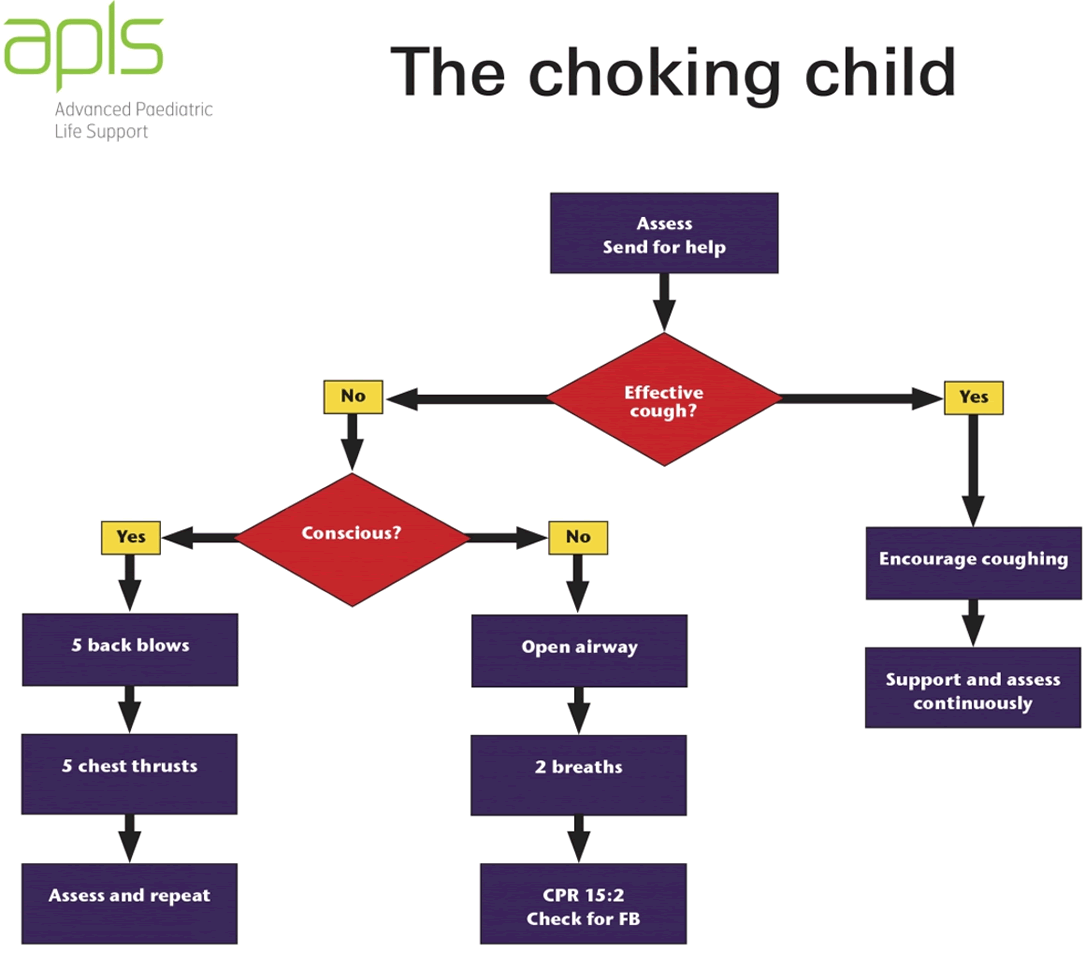
Supportive management is recommended initially in a child with no immediate airway concerns. Nurse the child in a position of comfort with cardiorespiratory monitoring and supplemental oxygen as required.
Nebulised adrenaline is not recommended due to the risk of dilation permitting distal movement of the foreign body resulting in complete airway obstruction.1
Foreign body removal with Magill forceps under direct visualisation must only be performed in controlled environments in a setting with skills and resources for advanced airway management.1
All children with suspected foreign body inhalation should be kept nil by mouth pending investigations and consultation with subspecialty teams, if required.
Apply topical amethocaine (or equivalent) in preparation for IV cannulation.
Avoid potentially distressing procedures in a child with upper airway compromise.
Lower airway foreign body
Bronchoscopy is recommended for diagnostic and/ or therapeutic purposes for the following children:
- history of foreign body inhalation or high index of suspicion for foreign body inhalation
- abnormal findings on physical or radiological examination
- ongoing symptoms despite normal physical and radiological findings
- unexplained atypical/prolonged respiratory symptoms that have failed to respond to standard medical therapy
A bronchoscopy may be indicated if these children develop otherwise unexplained respiratory symptoms within a month of the incident.
Seek ENT/Paediatric ENT advice in a child who presents with otherwise unexplained respiratory symptoms within a week of a choking episode.
Seek ENT/Paediatric ENT advice in a child who presents with abnormal physical examination and/or radiological findings more than a week after a choking episode, as there remains a high suspicion of inhaled foreign body.
Seek Respiratory or ENT/Paediatric ENT advice in a child who presents with no abnormal examination or radiological findings but has ongoing unexplained respiratory symptoms more than a week after a choking episode.
Disposition
When to consider discharge from ED
After discussion with an Emergency Senior Medical Officer of staff, consider discharge for a child with a history of a choking episode who meets the following criteria:
- has normal physical and radiological findings
- tolerates feeding
- remains asymptomatic following a period of observation.
When discharge is being considered the decision is taken by a senior clinician, and scaffolding follow-up appointment is in place.
Caregivers should be advised to seek medical attention and inform the doctor of a previous choking episode should the following symptoms develop within a month:
- persistent cough
- fever
- noisy, fast or difficulty breathing or grunting
Provide the following prevention advice to all caregivers:
- hard and/ or round foods should not be offered to children younger than four years of age
- infants and young children should be fed when sitting upright and with adult supervision
- small objects including marbles, small balls, coins, button batteries and balloons should be kept out of reach of young children
- follow the age recommendations on toy packages
When to consider admission
As per consultation, a child may be admitted under a specialist service for ongoing management.