Purpose
This document provides clinical guidance for all staff involved in the care and management of a child presenting to an Emergency Department (ED) in Queensland with a suspected or confirmed foreign body in the nose.
This guideline has been developed by senior ED clinicians and Paediatricians across Queensland, with input from ENT specialists, Queensland Children’s Hospital, Brisbane. It has been endorsed for use across Queensland by the Queensland Emergency Care of Children Working Group in partnership with the Queensland Emergency Department Strategic Advisory Panel and the Healthcare Improvement Unit, Clinical Excellence Queensland.
Introduction
Nasal foreign bodies are more common in the following children:
- aged two to five years
- intellectual impairment (may have multiple foreign bodies and repeated episodes)
Common foreign bodies include food, paper and small toy parts. Most nasal foreign bodies are found in the anterior nasal cavity between the floor of the nose and inferior turbinate.1 High rates (92-98%) of successful removal in ED have been reported.
Button batteries
Button batteries require immediate removal due to the risk of necrosis of the surrounding tissue.
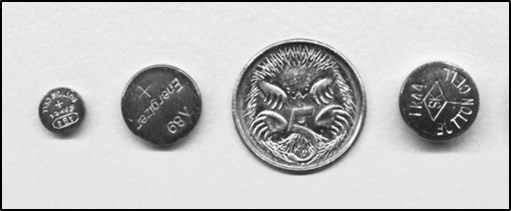
There are two main mechanisms by which button batteries can cause necrosis:
- where there is sufficient retained battery charge, hydrolysis and creation of hydroxide ions in adjacent tissues leads to mucosal burn at battery’s negative pole
- direct pressure
Despite prompt removal, the risk of injury can continue up to weeks post-insertion due to residual alkali and weakened tissues.
Assessment
Alert
Button batteries require immediate removal to prevent necrosis of surrounding tissue and septal perforation.
When to suspect a foreign body in the nose
Most children with a nasal foreign body are asymptomatic. A history of insertion may be reported by the child or the caregiver. Delayed presentations are usually triggered by parents noticing blood stained purulent discharge or a bad smell.
Regardless of a history of insertion, consider a nasal foreign body in children presenting with any of the following symptoms:
- nasal occlusion
- epistaxis
- malodourous, purulent or blood-stained nasal discharge (usually unilateral but may be bilateral if multiple foreign bodies or in case of septal perforation)
- facial swelling and/or facial pain
Differential diagnoses for suspected nasal foreign body|
Upper respiratory tract infection
|
|
Rhinitis
|
|
Sinusitis
|
|
Unilateral choanal atresia
|
|
Tumour |
Investigations
X-rays are not routinely recommended as the objects inserted are rarely radiopaque but must be considered if there is a possibility of a button battery or paired magnets which cannot be directly visualised.
Contact Retrieval Services Queensland (RSQ) to arrange urgent transfer of a child with a suspected button battery and no X-ray facilities are onsite.
Management
Refer to flowchart [PDF 211.2 KB] for a summary of the emergency management for a child with a nasal foreign body.
Urgent ENT referral (onsite or via RSQ) is required for the following children:
- button battery in nose
- history of insertion and bleeding or airway issues
Refer to ENT as per local practices in the following circumstances:
- multiple unsuccessful attempts at removal prior to ED presentation
- foreign body is posterior and not easily visualised
- paired magnets or magnet and metallic object across nasal septum
- chronic or impacted foreign bodies with marked inflammation
- penetrating or hooked foreign bodies
Principals of foreign body removal
- first attempt offers the best chance of success
- choose the best method based on exact location, shape and composition of foreign body (see methods below)
- be aware of the risk of trauma and/or posterior displacement and aspiration in a poorly compliant child
Preparation for foreign body removal
- engage two staff members to assist (in addition to carer)
- provide developmentally appropriate information and encouragement and use demonstration or role play to prepare the child for the procedure
- position the child appropriately (upright or lying down)
- use auditory and visual distraction techniques and promote child’s coping skills
- prior to mechanical extraction, consider applying topical local analgesia such as Co-Phenylcaine Forte (5% Lignocaine, 0.5% Phenylephrine) at appropriate doses using flexible nozzle extension (maximum single dose of 3mg/kg Lignocaine) 10 minutes prior to removal (not routinely recommended prior to removal by positive pressure techniques)
- use a head lamp (+/- magnification) to optimise visualisation and allow the use of two hands
- consider using a nasal speculum to maximise visualisation (place in a cephalo-caudal orientation to avoid the nasal septum)
Blind attempts at removal are not recommended due to risk of posterior dislodgement and aspiration.
Alert
Topical nasal drops including local anaesthetic and vasodilators are contra-indicated in button battery cases. They may increase the risk of posterior displacement and aspiration or local necrosis.
Methods of removal
Recommended methods of removal include positive pressure or mechanical extraction. Positive pressure methods aim to push the foreign object anteriorly either completely out of nasal passage or into a visible range where it can be grasped by other instruments. These methods carry a theoretical risk of barotrauma including periorbital subcutaneous emphysema. Irrigation and use of glue are not routinely recommended.
Sedation is not recommended as may increase the risk of aspiration.
The risk of aspiration in foreign bodies that are unable to be removed is estimated to be 1 in 1,500 patients.2 Referral for elective removal is therefore acceptable with appropriate safety-net advice for the family.
Positive pressure removal methods for nasal foreign body
| Description |
|---|
Self-blow/
exhale technique | - recommended for removal of small, smooth, spherical objects in a cooperative patient (usually greater than three years of age)
| - child is encouraged to blow their nose whilst occluding the nostril opposite to the foreign body
|
| Parent’s kiss | - recommended for removal of small, smooth, spherical objects
- well tolerated even in small children without requiring restraint
| - caregiver seals the child’s mouth with their mouth whilst occluding the unaffected nostril then gives a short sharp puff of air to dislodge the foreign body
|
Mechanical extraction removal methods for nasal foreign body
|
Forceps
(including Magill, alligator, packing, toothed and non-toothed forceps)
| - recommended for soft, irregular small objects
- not recommended if object is smooth, round or friable
| - gently grasp the object with the forceps and pull out of nares
- avoid repeated grasping attempts as may push more posteriorly
|
Probe
(e.g. Jobson-Horne probe)
| - recommended for hard non-graspable objects which do not fully occlude nares
| - probe tip passed beyond and posterior to object and removed by pulling object anteriorly and out of the nare
|
| Suction | - recommended for smooth or spherical visible mobile objects
| - use micro suction tube (Schuknecht tube or Frazier tip) attached to wall suction to form a solid seal between tube and object
|
Balloon catheter
(e.g. small foley or commercial catheter)
| - recommended for smooth round foreign bodies which do not fully occlude the nasal passage
- risk posterior displacement of foreign body
| - lubricate the catheter and advance past the object, partially inflate the balloon and withdraw
|
Magnetic device 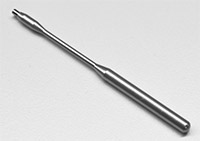
| - consider for removal of metallic objects such as ball bearings or button batteries if visible
- risk pushing foreign body further into nose
| - slowly and safely introduce the magnet into the nose until an audible or palpable click is produced at which point carefully withdraw
|
Refer to ENT as per local practice if first attempt at removal of foreign body (via any method) is unsuccessful.
Post-removal care
- inspect nasal orifice to exclude co-existing foreign body and trauma
- examine other nasal and aural orifices for additional foreign bodies
Potential complications following removal of nasal foreign body
- rhinorrhoea
- epistaxis
- ulceration of the nasal mucosa
- perforation of nasal septum
- nasal or choanal stenosis
- infection
- ingestion
- sinusitis
- periorbital cellulitis
- meningitis
In the event of epistaxis, apply direct pressure to control the bleeding. Refer to Epistaxis guideline [PDF] (QH only).
Refer to ENT as per local practice in child with significant complications.
Disposition
A child may be discharged following successful removal of the foreign body.
On discharge, provide accident prevention advice to caregiver/s including:
- safe storage of small objects including marbles, coins, button batteries and balloons to ensure out of reach of infants and young children
- ensuring toys for play are appropriate for developmental age
Follow-up
- advise caregiver/s to seek medical attention if child experiences any signs or symptoms of complications such as fever, purulent nasal discharge, epistaxis, facial pain and/or swelling
- referral to ENT as per local practice any child with significant complications following foreign body removal