Thickened fluids for children
Thickened fluids are safe for most babies and children, however only certain products should be used depending on your child’s age.
Thickened fluids are not recommended for:
- babies born prematurely who are not yet term age (e.g. baby born at 26 weeks who is now 35 weeks)
- children with a history of necrotizing enterocolitis (NEC).
Talk to your child’s speech pathologist, dietitian and/or medical team if your child is on a ketogenic diet, has an allergy to thickener ingredients, has monosaccharide intolerance or problems that affect carbohydrate absorption/digestion.
What liquids do I need to thicken?
You must thicken every drink that your child has, this includes (but is not limited to):
- expressed breast milk
- water
- milk
- formula
- juice (including juice boxes)
- soft drink.
See the ‘Food and fluids to avoid for children on thickened fluids’ fact sheet for more information about foods/drinks your child must avoid.
Do I need to modify my child’s drinking utensils?
You might need to change or modify your child’s feeding equipment to make sure they can drink safely. Your speech pathologist can help you find appropriate teats or cups.
Levels of fluid thickness
There are four different levels of thickened fluids. Your speech pathologist will tell you which level is right for your child. Fluids that have not been thickened are called ‘regular’ or ‘thin’ fluids
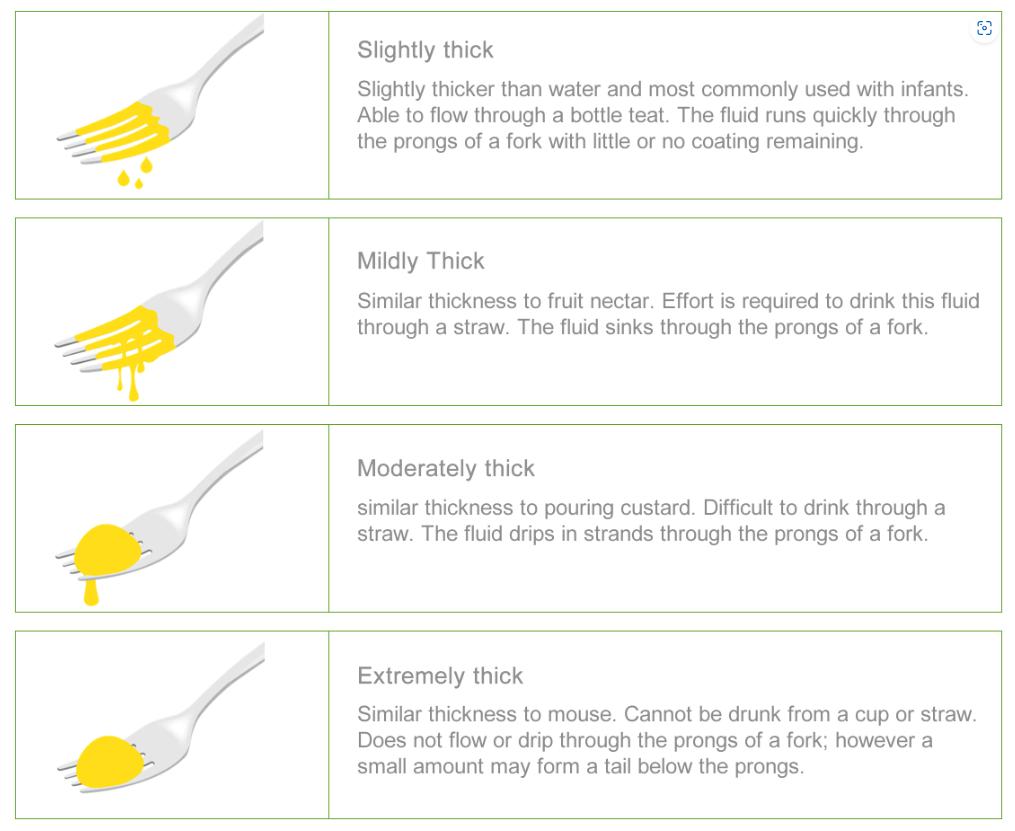
It is important to make sure the fluids you give your child are the correct thickness level. If you prepare fluids that are too thin, your child is at risk of aspiration (where fluid goes into the lungs). If you prepare fluids that are too thick for your child, they may not be able to drink enough to stay hydrated.
How do I prepare my child’s thickened drinks?
To prepare your child’s drinks, you will need your child’s drink and thickening product. Depending on your child’s thickener, you may also need something to mix the thickener in with (e.g. fork, spoon or whisk).
- Measure out the correct amount of fluid as per the thickener instructions (e.g. 100ml, 190ml)
- Measure out the correct amount of thickening product as per the thickener instructions (e.g. 1 scoop)
- Mix together as per thickener instructions (e.g. shake, stir, blend)
Most thickening agents used with children over the age of one are stable and can be kept for 24 hours. This means that you can prepare a large volume of fluids in the morning, and then send to day-care or school with your child or keep them in the fridge at home.
Contact us
Speech Pathology Department
Queensland Children’s Hospital
501 Stanley Street, South Brisbane 4101
t 07 3068 2375
e LCCH-SPEECH@health.qld.gov.au
References
- American Speech-Language-Hearing Association (2017). Pediatric Dysphagia. Retrieved from: http://www.asha.org/PRPSpecificTopic.aspx?folderid=8589934965§ion=Treatment
- Dietitians Association of Australia and the Speech Pathology Association of Australia Limited. (2007). Australian standardised definitions and terminology for texture-modified foods and fluids, Nutrition & Dietetics, 64 (Suppl. 2), S53–S76.
- Gosa M, Dodrill P: Effects of time and temperature on thickened fluids. In Proceedings of the American Speech Hearing Association Conference, New Orleans, November 2009.
- Groher, M., & Crary, M. (2015). Dysphagia: Clinical Management in Adults and Children. Saint Louis: Elsevier Health Sciences.
- CreativeCommons Attribution. (2017). Complete IDDSI Framework detailed definitions. Retrieved from http://iddsi.org/Documents/IDDSIFramework-CompleteFramework.pdf (PDF)